Is 22 or 24K Gold Better?
Neither is better in the abstract. 22K is harder, 24K holds more gold, and what you are buying decides which of those matters. Pure gold is too soft to withstand wear, so jewellery gold is alloyed. 22 carat, marked 916, is 91.6% gold, and a 916 piece is priced at the 22K gold rate in Nagercoil. 24 carat is 99.5% gold or finer: a hallmarked piece of jewellery is marked 24KS995, and a BIS-licensed bar or coin is 995 or 999 fine. For a piece you will wear, the alloy matters; for gold you mean to hold as metal, the gold content does.
22K vs 24K gold: which one, for what you are buying
The difference between 22K and 24K gold is gold content: 91.6% against 99.5% or more. Everything else follows from it, from how the metal wears to how much gold a gram of it holds. Start from the purchase rather than the purity.
Scroll across the table to read all three columns.
| What you are buying | Caratage | Why |
|---|---|---|
| A piece to wear | 22K, marked 22K916 | Pure gold is too soft to withstand wear, which is why jewellery gold is alloyed. 22K is also the purity of the Nagercoil gold rate on this site. |
| A stone-set piece | 22K (916) or 18K (750) | 18 carat is a hallmarking grade of its own, with its own published rate, and it is never priced as a share of the 22K rate. |
| A 24 carat piece of jewellery | 24K, marked 24KS995 | A permitted hallmarking grade for jewellery and artefacts. It is the highest-gold grade a hallmarked piece can carry, and the least alloyed. |
| Gold you intend to hold as metal | 24K, as a hallmarked bar or coin | A BIS licence for a refinery or mint covers bullion and coin at 999 or 995 fineness, and the mark goes on during manufacture. You pay the seller's price, not the benchmark. |
For a piece bought partly to wear and partly to hold, check the shop's exchange terms as well as the caratage: the terms set what the shop will pay for it later.
Is 24K gold 999 or 916?
Never 916, because 916 is 22 carat. Carat counts gold in twenty-fourths and fineness counts it in thousandths, so 22 parts in 24 is 916 parts in 1,000, which is 91.6%. The 24 carat numbers sit at the other end of the same scale: a hallmarked article carries the mark 24KS995, and a BIS-hallmarked bar or coin is 999 or 995 fine.
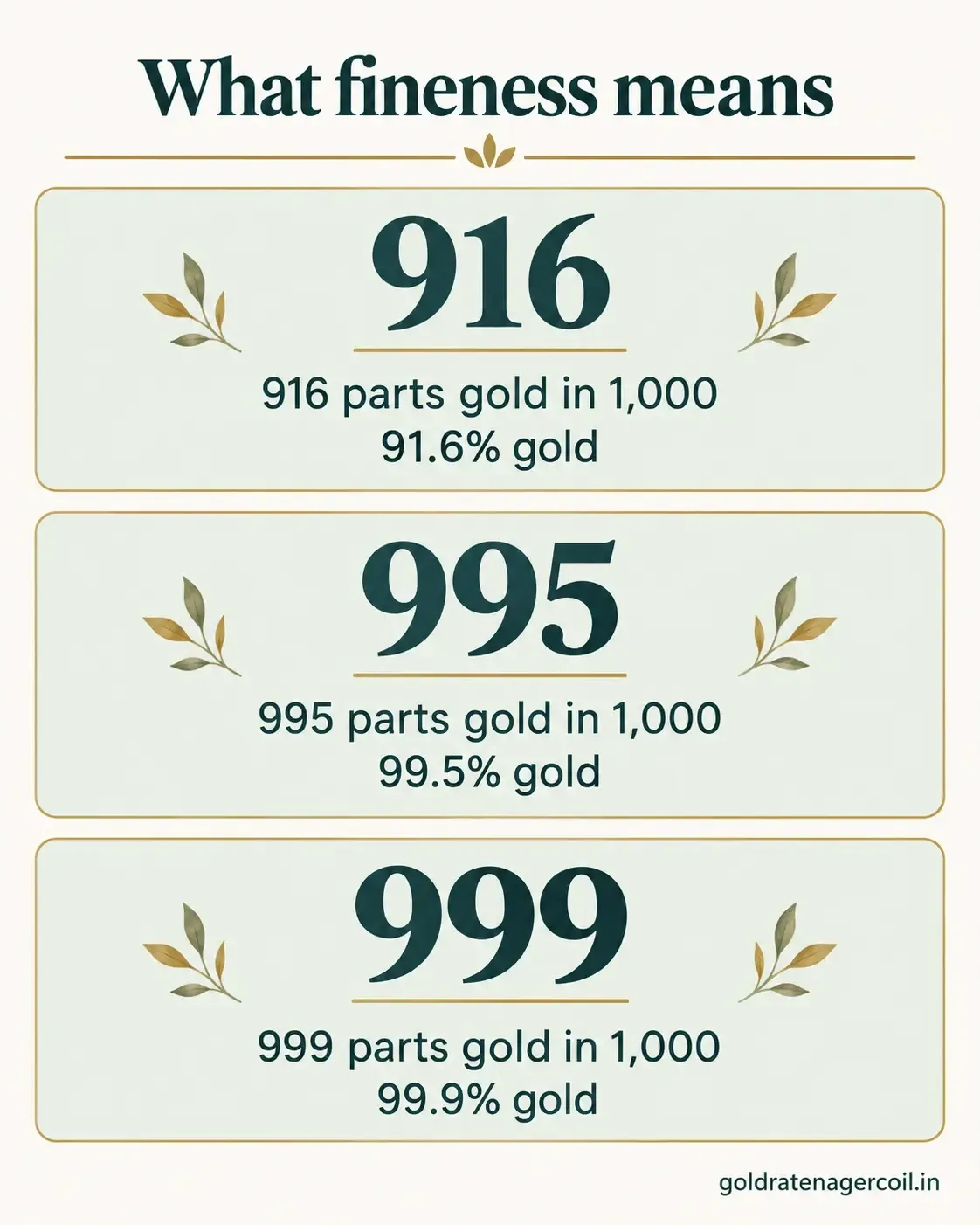
| Mark | Carat | Gold content | Where you meet it |
|---|---|---|---|
| 22K916 | 22 carat | 91.6% | Jewellery, and the purity of the rate on this site. |
| 24KS995 | 24 carat | 99.5% | The 24 carat grade for a hallmarked article. |
| 999 | 24 carat | 99.9% | Bars and coins from a licensed refinery or mint, and the fineness the national benchmark quotes. |
Is 24K gold 100% pure gold?
No, and no commercial grade claims to be. A BIS hallmark certifies a bar or coin at 999 or 995 fineness, which is 99.9% or 99.5% gold, and the highest grade for an article is 24KS995. "Pure gold" is how 24 carat is described, not a measured 100%. The gap between 999 and 995 is four parts in a thousand. The gap between either of them and 916 is what lets a piece be worn.
Mandatory hallmarking covers 14K, 18K, 20K, 22K, 23K and 24KS, and none of them is KDM, which names a soldering method: what 916 means on a hallmark.
Compare a Nagercoil quote against the right rate
The two figures on this site answer different questions. The latest 22K gold rate in Nagercoil is ₹14,010 per gram, ₹1,12,080 per pavan (8 grams), as on . The 24K figure is the national benchmark for 999 fine gold, ₹15,211 per gram at the closing rate of 25 September. Hallmarked 24K articles are 995 fine, ₹15,150 per gram on the same benchmark.
The rate above is for the metal alone: a shop's board rate may differ, and making charges, any separately quoted wastage and GST come on top of it. The benchmark is not a Nagercoil quote either, and coins carry a premium over it.
Ask the shop for its own 22K rate per gram, the date it was set and the net gold weight. If a 22 carat price is handed to you as a 24 carat figure scaled down, that is arithmetic rather than a quoted rate. The 22K rate is a figure of its own, not 91.6% of any 24K figure, and one purity is never worked out from another here.
Compare the whole bill, not the rate
Equal weights are not equal gold. One pavan of 22K holds 7.328 grams of gold; one pavan at 24KS995 holds 7.96 grams, and at 999, 7.992 grams. That is weight × fineness ÷ 1,000, and it is why a 22K price and a 24K price per gram cannot be compared directly: each buys a different amount of gold.
Compare two actual offers by their payable totals: get both quotes in writing and put each through the calculator. This site cannot put a real 22K purchase and a real 24K purchase side by side, because its two figures come from different publishers on different dates and a coin or bar is sold at the seller's price. What it can show is the part of any bill that is not metal. The example below is that, and only that: one metal value, with and without a making charge.
Example: what a making charge adds to 8 grams
Both columns at ₹14,000 per gram, a round example rate rather than today's, and a 12% making charge that is an illustration, not a Nagercoil shop's figure. This is not a 22K against 24K comparison.
Scroll across the table to compare both columns.
| Bill line | With a 12% making charge | With no making charge |
|---|---|---|
| Gold value 8 g × ₹14,000 per gram | ₹1,12,000 | ₹1,12,000 |
| Making charge 12% of the gold value | ₹13,440 | none |
| GST at 3% | ₹3,763 | ₹3,360 |
| Total | ₹1,29,203 | ₹1,15,360 |
| Of that, not metal | ₹17,203 | ₹3,360 |
The making charge and the tax on it add ₹13,843 to the same metal value: ₹17,203 of that bill is not metal, against ₹3,360 with no charge. That share moves with the shop's quote, not with the caratage.
The making charge is the shop's price for the design, not a published rate, and a separately quoted wastage line sits on top of the gold value in the same way.
The tax is the same either way. GST is 3% of the transaction value of the jewellery, making charge included, and coin sits in its own heading at the same 3%, so purity does not change the rate. It comes to more when a making charge is paid only because the charge is inside the value it is worked on.
The no-charge column is not a coin price: a coin is sold at the seller's price rather than at the benchmark. The making-charge, wastage and coin figures here are an illustration, not a Nagercoil shop's price.
Settle the exchange and buyback terms before you choose
What gold fetches when it goes back over the counter is the part of this decision no rule settles. Three things are settled:
- You may sell old jewellery to a jeweller whether or not it is hallmarked.
- Selling your own old gold is not a supply you are taxed on; the jeweller does not collect tax from you on that sale.
- When a new piece is bought partly by handing over old metal, the tax rule values the new piece at its open market value, not at the cash you top up with.
Everything else is the shop's own terms: what it deducts for melting, whether it pays the day's rate or a rate of its own, whether any part of the making charge comes back on an exchange, and what proof of purchase it wants. None of that is set by the hallmarking rules or the tax rules, so each retailer sets its own.
Some retailers publish their terms, and they can turn on purity. As of 19 September 2026: Malabar Gold & Diamonds promises 100% value on 22K gold exchanged, against net weight, with "competitive rates for other karats", and CaratLane's terms say old gold cannot be exchanged for gold coins. Those are each retailer's own published terms, not a market practice and not the terms at any Nagercoil counter. Where a shop publishes a policy, read it before you buy, and confirm in writing that it applies at the branch you are buying from.
Questions to ask before you buy
- "If I bring this piece back, what do you deduct?" Ask for the deduction as a percentage and as rupees on this piece, at today's rate.
- "Do you buy back at the day's rate, or at a rate of your own?" A buyback rate that is not the day's rate is a second price you were not quoted.
- "Does any of the making charge come back on an exchange?" Ask for the answer in writing on the bill, not at the counter.
- "What do you need from me to accept it back?" Ask whether the original invoice is required. Keep the bill either way: it has to show the purity, the net gold weight and the hallmarking charge, and a later claim about the piece rests on it.
No exchange or buyback terms have been collected at a Nagercoil counter for this site. Every answer to those questions is the shop's own, so get them before you pay rather than afterwards.