Gold Wastage Charges and the VA Line
A wastage charge is a percentage charged on the gold value of a piece, on top of the metal. It is not gold taken out of what you receive. Written as a percentage of value, as rupees per gram or as grams added to the weight, it comes to the same money at the same rate. Estimates often label it VA, which is reported both for the wastage alone and for the making charge and the wastage together, so the first thing to establish is what the percentage covers. Then the question that changes your bill is whether it sits inside the making charge you were quoted or on top of it.
Nothing in the hallmarking rules or the tax on jewellery defines a wastage percentage or caps it for a shop sale. Gold wastage charges are a price like making charges on jewellery, quoted piece by piece.
What gold wastage charges are, and what VA covers
Wastage is charged on the premise that gold is lost in working a piece: filings, dust, metal left on the polishing wheel, losses in melting and drawing. Estimates print it as VA, for value added or value addition.
What a VA figure covers is not settled by the word itself. A jeweller's own buying guide reports VA as the wastage line alone; a financial publisher's guide to jewellery pricing reports value-added charges as the making charge, the wastage and other fees together. Both usages are in circulation, so ask which one the estimate in front of you follows, and ask for the split when it turns out to be the combined figure.
Wastage itself is a percentage of the gold value, so it rises with the rate on its own: the same percentage on the same design costs more when gold is dearer, without the work changing. It is also separate arithmetic from the making charge, even when one figure on the estimate covers both. Because nothing fixes the percentage, two shops can quote different wastage on the same design, and neither figure tells you what the other includes.
Wastage as a percentage, as rupees per gram, or as added grams
A wastage quote reaches you in one of three forms: a percentage of the gold value, a figure in rupees per gram of net gold, or grams added to the weight being priced. At the same rate per gram those are the same amount of money, so convert whichever one you were given.
Example: 5% wastage on one pavan
8 g of net 22K gold at ₹14,000 per gram, a round example rate rather than today's. The percentage is an illustration, not a Nagercoil shop's figure.
- Gold value
8 g × ₹14,000 per gram - ₹1,12,000
- 5% of the gold value
- ₹5,600
- ₹700 per gram of net gold
₹14,000 × 5% - ₹5,600
- 0.4 g added to the weight
8 g × 5%, priced at the same rate - ₹5,600
The conversions need only the rate per gram the shop is using. Multiply the rate by the percentage for the per-gram figure: each 1% of wastage is ₹140 per gram at ₹14,000. Divide a per-gram wastage figure by the rate and multiply by 100 to get back to a percentage. Multiply the net weight by the percentage for the weight form.
Watch the weight form. 0.4 g of wastage is not 0.4 g of gold you take home: the article still weighs 8 g, and the extra grams are a charge written as weight.
Inside the making charge, or on top of it?
The word on the estimate will not tell you which of two quotes is dearer. A shop that quotes 16% for everything above the metal and a shop that quotes 12% making plus 5% wastage are describing different offers, and the second is the larger number: 12 plus 5 is 17, against 16.
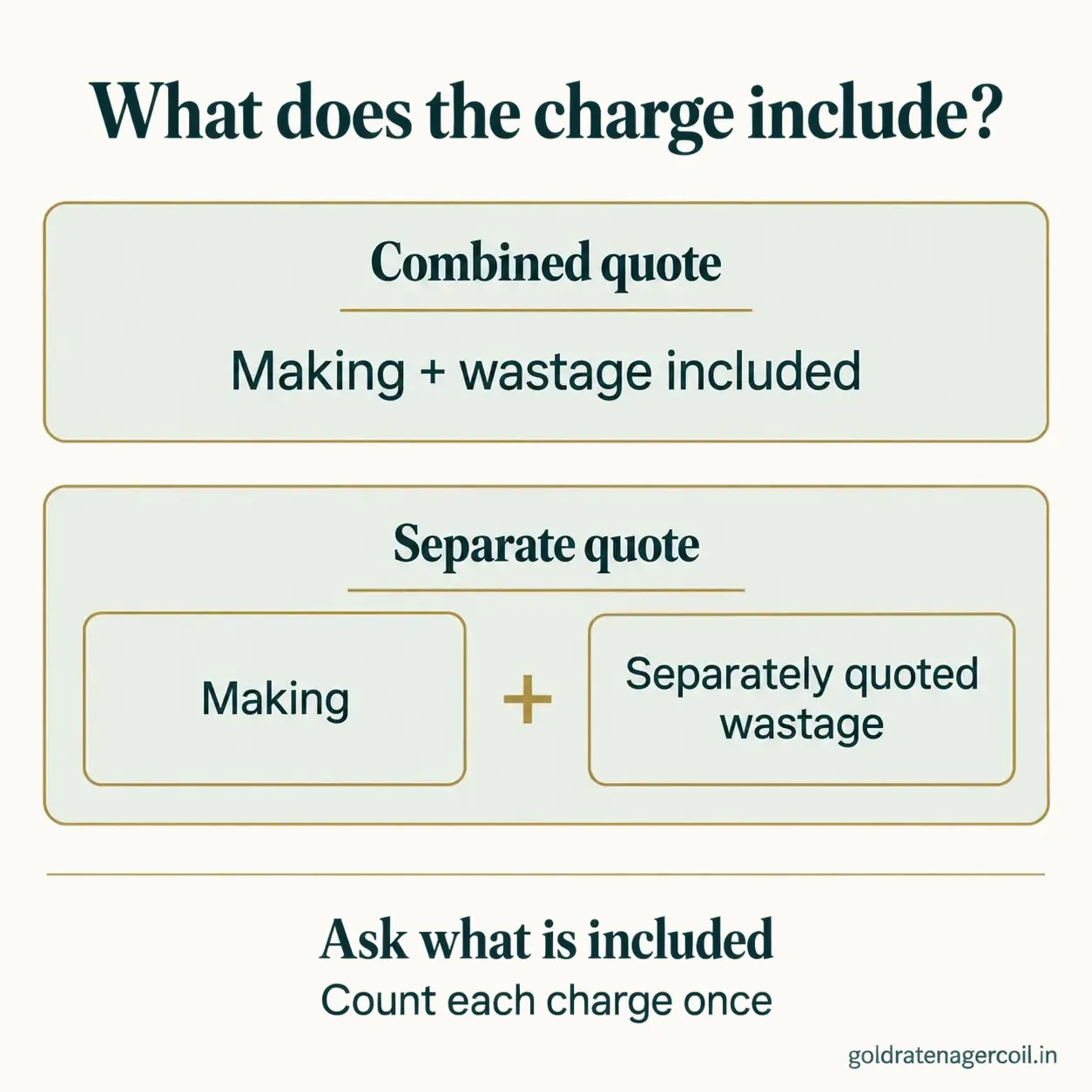
The same pavan, quoted both ways
8 g of net 22K gold at ₹14,000 per gram. Illustrative percentages, no stones and no other charges.
| Line | 16% all in | 12% making plus 5% wastage |
|---|---|---|
| Gold value | ₹1,12,000 | ₹1,12,000 |
| Making charge | ₹17,920 | ₹13,440 |
| Wastage | Included | ₹5,600 |
| GST at 3% | ₹3,898 | ₹3,931 |
| Total | ₹1,33,818 | ₹1,34,971 |
₹1,154 between them on one pavan, which is that one percentage point of gold value plus the tax on it.
The answer also decides what you enter in a calculation. Counting the wastage twice, once inside a quoted figure and once as its own input, overstates the bill; leaving out a percentage the shop does charge understates it. Both are percentages of the same gold value, so when you negotiate making charges, a point off either is worth the same in rupees.
What wastage adds to a one-pavan quote in Nagercoil
The latest 22K gold rate in Nagercoil is ₹14,010 per gram, ₹1,12,080 per pavan (8 grams), as on 25 September, 9:36 am. At that rate every 1% of wastage on a one-pavan piece is ₹1,121 of gold value before tax, so the gap between a 4% quote and an 8% quote on the same pavan is four times that figure.
Your jeweller's board rate may differ from it. Making charges, any separately quoted wastage and GST come on top.
Work the figure out on the shop's own rate per gram rather than this one, because a different board rate would turn up in the answer as wastage. Do it before you agree to the piece, since the percentage is settled at the quote.
What the bill has to show, and where wastage is not on it
Wastage is a charge, not gold you take home, and nothing obliges a shop to print it. The bill for a hallmarked article has to show each article separately, the net weight of precious metal, the purity in carat and fineness, and the hallmarking charge, and has to tell you that you can have the purity verified at a BIS recognised assaying and hallmarking centre. A wastage line is not among the things it must show, so ask for it on the written estimate before you agree to the piece, with the percentage and what it is charged on.
The weight that must appear is the article's own net precious-metal weight. If the weight being priced is larger than that, the difference is a charge rather than metal, whatever it is labelled. Ask to see the piece weighed: a registered jeweller keeps a balance accurate to 0.01 g available for customers, alongside the magnifier for reading the hallmark and its purity.
Is there a maximum wastage percentage?
Not for a shop sale. There is no published wastage rate, and neither the hallmarking rules nor the tax on jewellery sets one or caps it. The percentage on an estimate is the shop's own price.
Export accounting is a separate matter. Where gold is imported duty free and has to be accounted for against the jewellery exported, the Directorate General of Foreign Trade allows a maximum wastage or manufacturing loss of 2.25% by weight of the gold content for handcrafted plain jewellery and 0.90% where the process is mechanised, with 4.00% and 2.80% for handcrafted and mechanised studded pieces.
Those are allowances for accounting duty-free gold under that scheme. They do not cap what a shop may charge, they do not measure what any workshop loses, and a retail quote should not be judged against them. What settles the wastage on your bill is the estimate itself: what the percentage covers, and what it adds.
GST on a wastage charge
A separately quoted wastage line is part of what you are paying for the jewellery, so it is taxed along with everything else: for a finished piece bought from a jeweller, GST is 3% of the total transaction value of the jewellery, making charge included. The ₹5,600 of wastage in the example above adds ₹5,768 to the bill, tax included, so the tax is part of what a wastage percentage costs you. The rate is set by the kind of article rather than its caratage, as with all GST on gold jewellery.
Questions to settle before comparing two quotes
- "Is wastage charged on this piece, and at what percentage?" A quote with no wastage line and a quote with one are not comparable until you know this for both.
- "Is that inside the making charge, or on top of it?" The single question that decides which quote is dearer.
- "What does the VA figure cover?" Ask whether it is the wastage alone or the making charge and the wastage together, and get the split if there is one.
- "Is the percentage on the gold value or on the weight?" Same money at the same rate, but it tells you which figure on the estimate to convert before comparing.
- "What is the net gold weight, and which rate per gram are you using?" Both conversions need the rate, and the charge applies to net gold, never to the gross weight of a stone-set piece.
- "Will the estimate show wastage as its own line?" A written line is what you compare against the next shop, and what you check the final bill against.