GST on Gold Jewellery
GST on gold jewellery is 3% of the total transaction value of the jewellery, making charge included, whether or not the bill shows the making charge separately. That is the rate on a finished piece bought from a jeweller. On a sale within Tamil Nadu the 3% arrives as two halves, central tax and State tax at 1.5% each, which is why a bill carries CGST and SGST lines rather than one GST line.
The rate is the same at every caratage, and the same on coins and bars. The value it is charged on changes from bill to bill, because it takes in the gold, the stones and the making charge on the piece.
How much is GST on gold jewellery
Add the making charge to the gold, then take 3% of the whole. The split a buyer is most likely to meet instead, the metal taxed at one rate and the workmanship at another, is not the treatment the government gives.
A jeweller put that exact question to the government's FAQ on gems and jewellery: for a 10 g gold chain at ₹30,000, made up of ₹28,000 of gold and ₹2,000 of making charges, can GST be charged at 3% on the total, or 3% on the gold and 5% on the making? Its answer is 3% of the whole ₹30,000, which is ₹900. The ₹28,000 and ₹2,000 are the FAQ's illustration of the arithmetic, not a market making charge. Articles of jewellery sit at heading 7113 in the 3% schedule of Notification 9/2025, which replaced the 2017 schedule on 22 September 2025 and kept them there.
How to calculate GST on a jewellery bill
The tax is worked on the transaction value, which the CGST Act defines as the price actually paid or payable for the supply. It takes in incidental expenses, and any amount the shop charges for anything done in respect of the supply before it hands the piece over. The making charge, any separately quoted wastage charge, the stones' price and the shop's other charges for that piece are therefore all inside the figure the 3% is applied to. A discount agreed before or at the time of the sale comes out of that figure where it is recorded in the invoice, which is the route a counter negotiation takes.
Example: one pavan with charges and a discount
8 g of net 22K gold at ₹14,000 per gram, a round example rate rather than today's. The percentages and the stone price are illustrations, not a Nagercoil shop's figures.
- Gold value
8 g × ₹14,000 per gram - ₹1,12,000
- Making charge
12% of the gold value - ₹13,440
- Wastage
5% of the gold value, quoted separately - ₹5,600
- Stones
priced by the shop, not by weight - ₹2,500
- Taxable value
- ₹1,33,540
- GST at 3%
CGST ₹2,003 and SGST ₹2,003 - ₹4,006
- Total
- ₹1,37,546
Now suppose you settle on ₹2,000 off the making charge and the shop writes it on the bill. The taxable value falls to ₹1,31,540, the tax to ₹3,946 and the bill to ₹1,35,486. Every rupee off the taxable value takes 3 paise of tax with it, so the ₹2,000 is worth ₹2,060 when it is written on the bill before the tax is worked. A reduction given after the sale is a separate route with conditions of its own: it has to rest on an agreement made before or at the time of the sale, be linked to the invoice, and be settled by a credit note with the buyer's input tax credit reversed. Those conditions are written for registered buyers, and this page does not work them through. Settle the price before the bill is raised and the question does not arise.
How to check the GST on your gold bill
A tax invoice has to show the total value of the supply, the taxable value after any discount, the rate of tax and the amount of tax charged, with central tax and State tax given separately (rule 46 of the GST rules). So every figure the check needs is already printed on the bill.
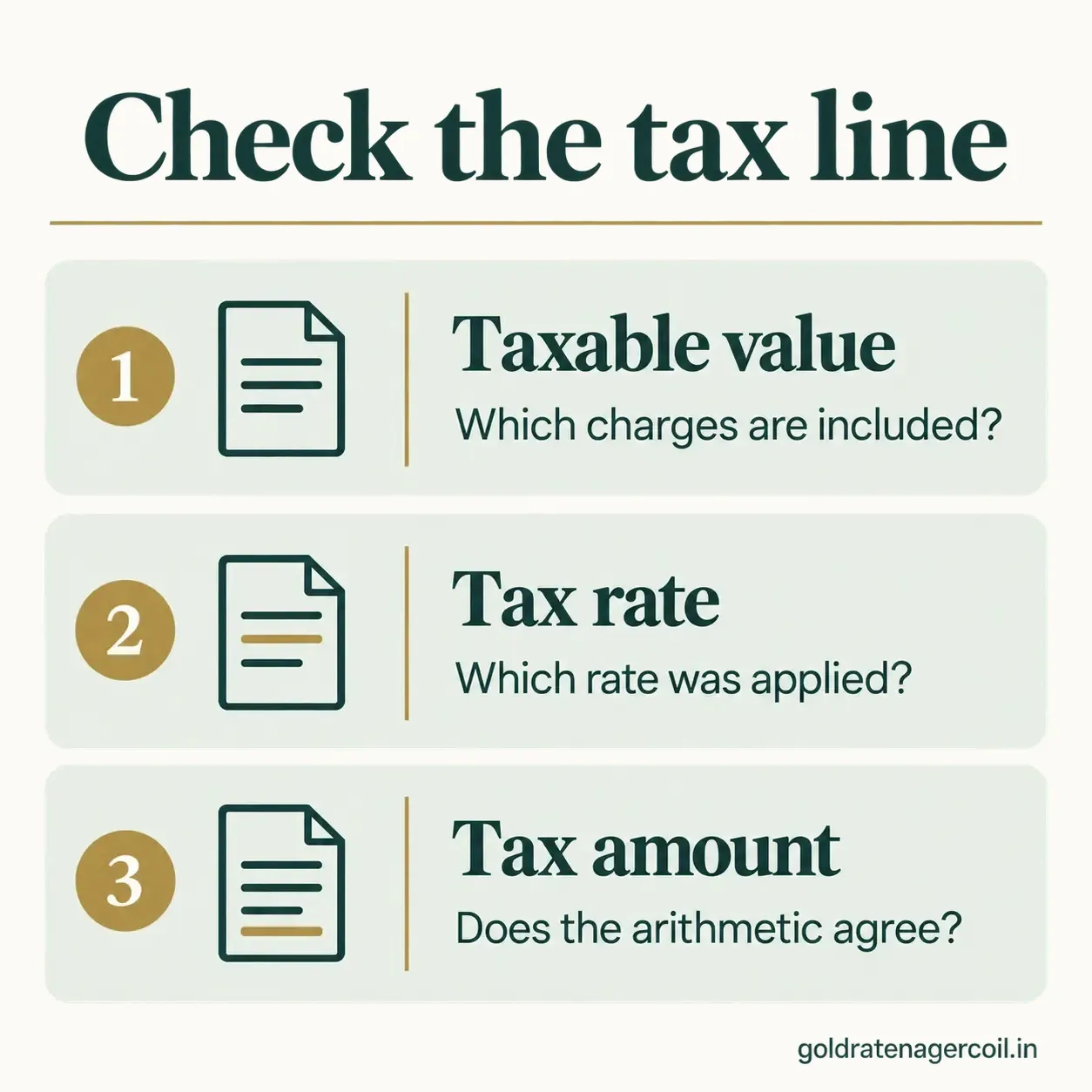
- Add the lines above the tax.Gold value, making charge, any wastage, the stones and any other charge for the piece, less a discount written on the bill. That sum should be the taxable value the invoice states.
- Take 3% of it.Multiply the taxable value by 3 and divide by 100. The CGST and SGST lines added together should come to that figure, each of them half of it.
- If the two do not agree, ask before paying.Ask which rate has been applied to which line. The FAQ above was asked exactly that question, about 3% on the whole against 3% on the gold and 5% on the making, and answered it on the whole transaction value.
The hallmarking rules ask the same bill for different things: each article described separately, the net weight of precious metal, the purity in carat and fineness, and the hallmarking charge. A bill has to satisfy both sets.
The 5% job-work rate, and where it does not reach
The 5% figure comes from the same FAQ, one question later, and there it answers a jeweller who issues gold to a job worker and gets finished goods back: the job worker, if registered, pays 5% on the job charges only.
Job work has a statutory meaning: treatment or processing on goods belonging to another registered person. A circular of the Tax Research Unit draws the line, and says the job-work entries cover only that: work on goods owned by someone outside the GST register falls under a different entry. Gold you own and hand over yourself is not goods belonging to another registered person.
So the 5% answer describes a registered job worker billing a jeweller. It cannot be carried across to a customer handing their own gold to a goldsmith, and this page states no rate for it. If you are having a piece made from your own gold, ask the maker to show the rate on the invoice and, where the amount matters, take it to someone who can advise on your particular transaction. On an ordinary shop purchase the question does not arise: the making charge is inside the value the 3% is worked on, not a labour line taxed at a rate of its own.
GST on 22K, 18K and 24K gold, coins and bars
The rate schedule lists goods by heading, not by caratage, so purity does not change the tax rate. A 22K chain, an 18K ring and a 24K article are all articles of jewellery under heading 7113 at 3%. Purity changes the gold value the tax is worked on, and nothing else.
Coin sits at heading 7118 and unwrought or semi-manufactured gold at 7108, both in the same 3% schedule, so a gold coin carries the same rate as a chain. A coin is taxed on the full price it is billed at, the same as any other article. Where that price carries a premium over the metal, whether or not a line on the bill names it, the premium is inside the taxable value; only where the billed price holds nothing above the metal value are the two figures the same.
GST when you sell or exchange old gold
For GST, selling your own old jewellery to a jeweller is not a supply you are taxed on. The Central Board's clarification of 13 July 2017 reasons that selling old gold is not your business, so the sale is not a supply in the course or furtherance of business, and the jeweller is not liable to pay tax on that purchase under reverse charge. Someone who deals in gold ornaments selling to a registered buyer is a different case. That answers the GST question and not the whole tax position: what a sale or an exchange does under the income-tax rules is outside this page, as the limits below say.
Exchanging old gold against a new piece
The new piece is still a supply to you, so it is still taxed. Part of what you give for it is metal rather than money, and the valuation rule for a supply paid for partly in something other than money sets the value at the open market value of that supply. The rule's own illustration is a new phone supplied for ₹20,000 with an old phone exchanged, where the price without the exchange is ₹24,000: the open market value is ₹24,000.
Read across to a counter, that points at the price of the new piece rather than the balance you pay in cash. Ask which figure the tax on your bill was worked on. The invoice has to state the taxable value it used, so the answer is already printed there. What the shop allows you for the old metal is its own terms and not a tax question: no rule fixes it, so ask for that figure separately. An allowance is worked out from the net weight, the tested purity and the deductions a quote names.
Checking the tax on a one-pavan quote in Nagercoil
The latest 22K gold rate in Nagercoil is ₹14,010 per gram, ₹1,12,080 per pavan (8 grams), as on 25 September, 9:36 am. The 3% on one pavan of metal alone comes to ₹3,362 at that rate, and every rupee of making charge, wastage or stone price on top of the metal adds 3 paise more.
Your jeweller's board rate may differ from it. Making charges, any separately quoted wastage and GST come on top.
Use the rate on your own bill rather than this one: the tax follows the value the shop actually charges.
Gold transactions the 3% answer does not cover
- A piece made from gold you supply yourself. The 5% job-work entry does not describe it, and the FAQ that settles the 3% does not reach it.
- A hallmarking or other service the shop bills and taxes on its own line. BIS prints its ₹75 per gold article with applicable taxes extra, and the FAQ settles the tax on the jewellery rather than on a service billed alongside it. Ask for such a line with its own tax shown beside it.
- What a shop owes when it resells old gold it has bought. That is the jeweller's liability on its own sale, not a charge on you.
- Customs duty on imported gold, any cess, and anything under the income-tax rules. None of them is worked out here.
Questions to ask before you pay
- "What is the taxable value on this bill?" It is a required line, and the tax should come to 3% of it.
- "Which rate has been applied to which line?" Ask whenever the tax does not come to 3% of the taxable value.
- "Is the discount recorded on the invoice?" A discount written on the bill before the tax is worked comes out of the value the tax is charged on. Settling it afterwards puts it on the separate post-sale route instead.
- "Does this quote include GST?" A figure given before tax will always look cheaper than the same piece quoted after it.
- "On this exchange, what value has the tax been worked on?" The new piece's own price and the cash balance are different figures, and the bill states which one was used.
- "Will the bill show the net weight and the purity as well as the tax?" For a hallmarked article it has to, and those lines are what any later claim rests on.