How to Calculate an Old Gold Exchange Rate
What old gold is worth is one multiplication: the net gold weight times the rate for the purity it actually tests at. Whatever a shop takes off after that is its own terms, not a rule. An offer handed across the counter has already settled those three things for you: what counted as gold, what purity it tested at, and what came off the top. Ask for the three figures and the offer becomes something you can check.
The estimate below works an old gold exchange rate out from the weight, the tested purity and the deductions a quote names, for checking an offer against. It is not a payout: a test and the shop's own terms settle what you are paid. The gold value calculator works the same metal value, and prices a new piece with its charges. No deduction is filled in, because no rule sets one.
Start from net gold weight, not what the piece weighs
The scale gives the gross weight: the gold, and with it the stones, the enamel, the lac or wax inside a hollow bangle, the thread on a necklace and any non-gold fitting. Only the gold is priced as gold. What is left once the rest comes off is the net gold weight, and that is the weight an exchange is worked on.
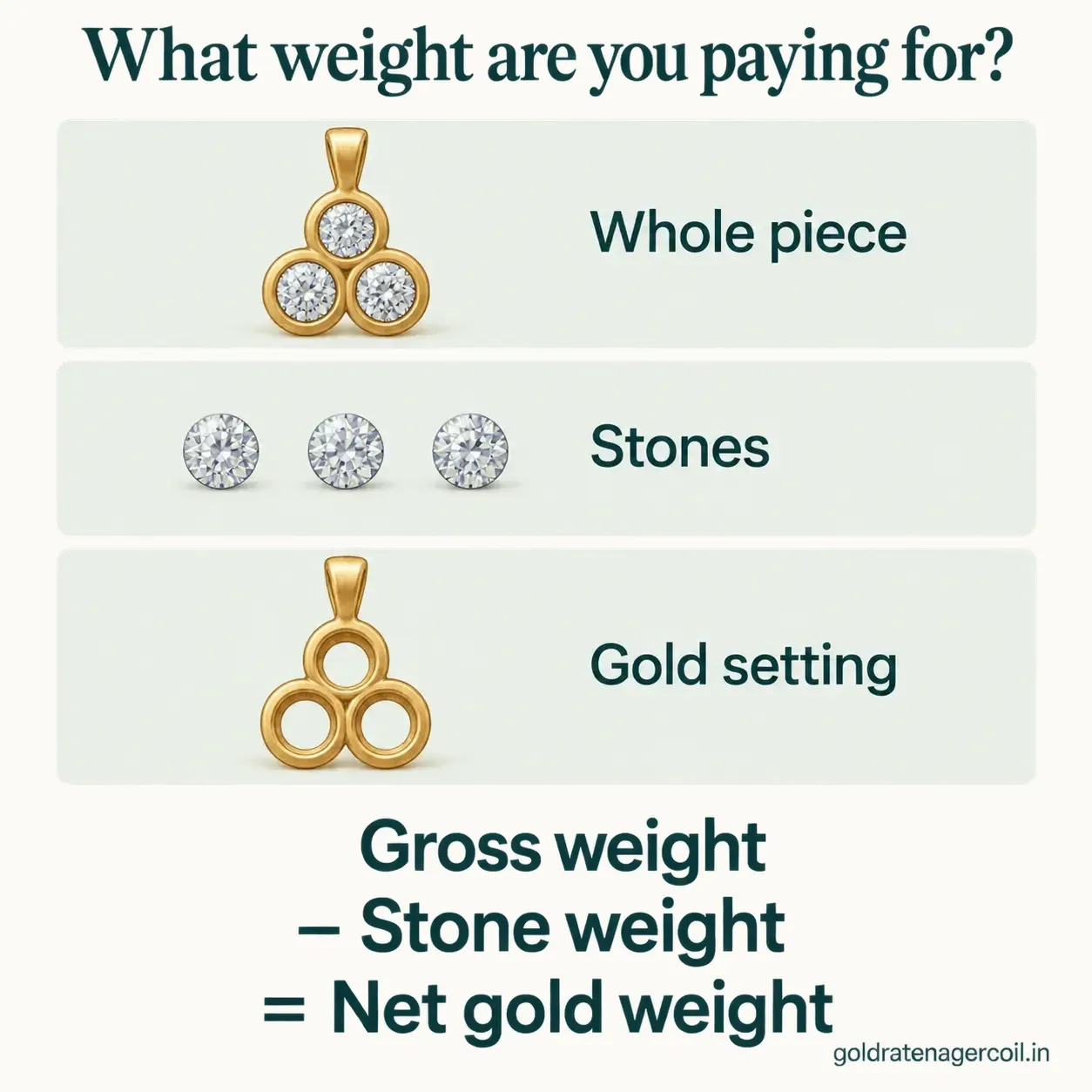
Three grams of stones in a 22 g piece is weight that is not priced as metal, which is ₹42,030 at the 22K rate below. Malabar's published exchange promise is written against net weight, and the same page describes its tags as showing gross weight, stone weight and net-gold weight separately. Ask which of those three your offer was worked on.
A registered jeweller has to keep a balance accurate to 0.01 g available for customers, so ask to see the piece weighed rather than taking a figure read out to you. If you still have the bill from a hallmarked purchase, the net weight of the precious metal is already printed on it: a bill for a hallmarked article has to give it, along with the purity in carat and fineness.
Then the purity it tests at, not the one on the tag
Purity is written as fineness, parts of gold per thousand. 916 is 22 carat, 750 is 18 carat, and 995 is the grade a 24 carat hallmark carries. A hallmark states the fineness the article was assayed at, and a mark already on a piece stays valid; where there is a HUID you can check it in the BIS Care app before relying on it. What tells you nothing is an unhallmarked piece, a mark too worn to read or verify, or a piece altered or re-joined since it was marked. Those are the ones a test is for.
Two tests are in use and they answer different questions. The karatmeter is X-ray fluorescence: quick, and it leaves the piece intact. In BIS's own guidelines it gives the gold content of the surface only, the reading may vary by 5 parts per thousand, and a purity certificate cannot be issued on it alone. Fire assay, the cupellation method under IS 1418, is the accurate one, and it is destructive: 300 to 500 mg of the article has to be taken as a sample.
On a 22 g piece at the 22K rate below, the difference between a reading of 916 and one of 911 is ₹1,682. Ask which method produced the number your offer rests on, and ask to see the reading.
You can have it tested before you decide
Purity is one figure in this calculation you can establish before walking into a shop, and unlike the net weight printed on an old bill it is one you may not have on paper at all. BIS's guidelines for testing old gold lying with consumers let you take pieces to a recognised assaying and hallmarking centre, hallmarked or not: up to ten pieces count as one mixed lot, the jewellery is weighed in front of you, each article is tagged with a serial number, each is read by XRF, and the purity is then determined by fire assay once you have consented to how the sample will be taken.
The article comes back, and so do the pure gold cornets and the remnants of the sample. Where the fire assay is done the same day, all of it is returned that day. The report form records the XRF reading, the fire-assay result in parts per thousand as the mean of two values, the weight received, the weights returned, and whether the piece was hallmarked. For that testing BIS sets ₹45 per article with a minimum of ₹200 for one lot, which is a separate charge from the hallmarking fee a jeweller pays to have new work marked, and its hallmarking FAQ puts a consumer's fire-assay test at ₹200.
The sample is taken by scraping, drilling or cutting, so the piece comes back with slight damage, and BIS says so in the same guidelines. A report establishes purity, not price: what a shop offers for metal of that fineness is still the shop's own terms.
BIS's list of recognised centres, read 20 September 2026, carried seven at Kanyakumari-district addresses, three of them in Nagercoil itself. The list gives no opening hours and does not say whether a centre takes a consumer's work at its counter, so call before setting out.
How an old gold exchange rate is worked out
A rate reaches you in one of two forms. Either it is a rate per gram for your gold as it tested, and the multiplication is direct. Or it is a board rate for a stated purity, a 22K rate for example, in which case it has to be converted before it says anything about a piece that tests lower.
The conversion is proportional to the gold in the metal: rate for your purity = quoted rate × your fineness ÷ the fineness the quoted rate is for. A 916 rate of ₹14,000 applied to metal testing 890 is ₹14,000 × 890 ÷ 916, which is ₹13,603 per gram.
A buying rate is the shop's own figure, and it is not the rate on this site. The Nagercoil rate is a 22K figure for buying, not selling; it tells you the region an offer should be in and nothing more. Work your sum on the rate you were actually given, and ask which purity that rate is for before you use it.
Malabar publishes 100% value on 22K gold exchange with “competitive rates for other karats”, so the percentage and the purity it applies to are two separate questions. Which of the two your piece falls under decides whether the headline covers it.
Estimate the exchange value
Enter what you were told: the weight the shop worked on, the purity the test gave, the rate and the purity that rate is for, and each deduction the quote names. Every deduction starts at zero here, so nothing comes off unless the quote said it would.
Estimated exchange value
Worked from the Nagercoil 22K rate, as on 25 September, 9:36 am. Replace it with the rate you were given.
- Net gold weight
22 g gross, with nothing deducted as non-gold - 22 g
- Rate for the tested purity
₹14,010 per gram, quoted for 916 fineness — the purity the test gives - ₹14,010 per gram
- Value of the gold
22 g × ₹14,010 per gram - ₹3,08,220
- Estimated exchange value
- ₹3,08,220
An estimate from the figures entered, not a quote and not a payout. Nothing typed here is stored or sent anywhere.
Example: a 22 g piece with 3 g of stones, testing at 890
At ₹14,000 per gram quoted for 916 gold, a round example rate rather than today's. The test result is an illustration: only a test tells you what a particular piece is.
- Net gold weight
22 g gross less 3 g of stones and non-gold - 19 g
- Rate for 890 fineness
₹14,000 × 890 ÷ 916 - ₹13,603
- Value of the gold
19 g × ₹13,603 per gram - ₹2,58,450
- 2% deduction, if the quote names one
An illustration; no percentage is assumed - −₹5,169
- Estimated exchange value
- ₹2,53,281
The 3 g of stones is ₹40,808 against pricing the whole 22 g as gold. Had the piece tested at 916 rather than 890, the same 19 g of metal would have come to ₹2,66,000 before any deduction, ₹7,550 more.
The deductions a quote can carry
There is no standard deduction. Neither the hallmarking rules nor the tax on jewellery fixes one or caps it, and published exchange terms differ from each other, so a percentage is only ever the figure on the quote in front of you.
CaratLane's published exchange terms name two deduction heads, handling charges and de-alloying charges, and show both at nil, marked valid only for a limited period. That is an offer with an end date, not a standing policy, so the figure that counts is the one on your own quote. The same terms say old gold cannot be exchanged for cash or gold coins, that the piece has to be plain gold above 9 carat, and that you sign a declaration that the gold is given for cutting or melting, that it will not be returned, and that the karatmeter reading is acceptable to you.
At any counter, ask for each deduction as its own line with what it is charged on, and ask whether the value is paid in money or only against a new purchase. A percentage comes off the value of the gold; a flat charge comes off in rupees. The estimate above takes both, and takes neither unless you enter it.
One thing is not a deduction, because it was never in the metal: the making charge, any wastage, the stones' price and the GST you paid when the piece was bought. An exchange starts from the gold, which is why a piece comes back at less than it cost even when the rate has risen.
Checking an offer against the Nagercoil gold rate
The latest 22K gold rate in Nagercoil is ₹14,010 per gram, ₹1,12,080 per pavan (8 grams), as on 25 September, 9:36 am. One pavan of metal testing at 916 is ₹1,12,080 of gold at that rate, and every ten points of fineness on that pavan is ₹1,224.
Your jeweller's board rate may differ from it, and a buying rate for old gold is the shop's own figure. No standard deduction exists, so the terms on your quote are the only ones that count. One Nagercoil jeweller, Lalitha Jewellery, publishes its own for a purchase plan. Kalyan Jewellers Nagercoil advertises a deduction-free exchange without publishing what it covers. Malabar Gold Nagercoil publishes two figures that differ, one for an exchange and a lower one for cash. Thangamayil Jewellery Nagercoil publishes the formula its cash offer is worked from, a fixed amount a gram below its rate and a handling charge.
Work the sum on the rate the shop gave you rather than on this one, because a rate that differs from the one you assumed turns up in the answer as if it were purity.
Tax when you sell or exchange old gold
For GST, selling your own old jewellery to a jeweller is not a supply you are taxed on: the sale is not made in the course or furtherance of business, so the jeweller owes no reverse-charge tax on buying it. That answers the GST question and not the whole tax position: what a sale or an exchange does under the income-tax rules is not worked out here, or anywhere on this site. Exchanging it against a new piece is a different question, because the new piece is still a supply to you, and the rule for a supply paid for partly in something other than money values it at its own open market value rather than at the cash balance you hand over.
A sale or an exchange transfers the gold and ends your ownership of it. A gold loan is borrowing against a piece you keep title to, pledged and meant to come back, and nothing here estimates one.
Checking the offer against your estimate
Four figures make an offer checkable, and all four should be on paper before anything is cut or melted: the weight the offer was worked on, the purity reading and the method that produced it, the rate per gram together with the purity that rate is for, and each deduction with what it is charged on.
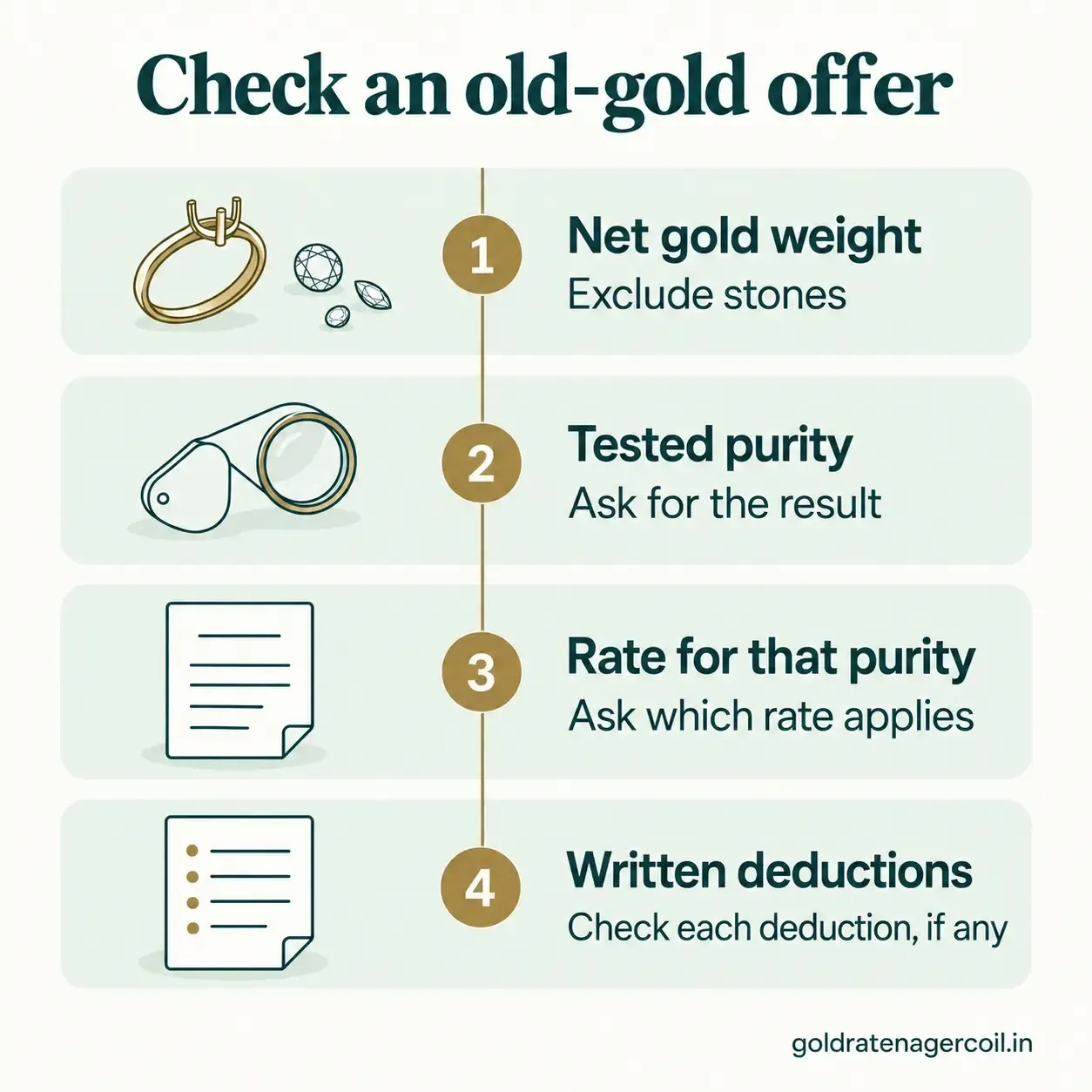
Get them first, because melting ends the comparison. Published terms have you sign that the gold is given for cutting or melting and will not be returned, and once a piece is a lump there is nothing left to take to a second counter. An unhallmarked family piece is not unsellable: a consumer may sell old jewellery hallmarked or not. What it fetches is a matter of the test and the terms.
If your estimate and the offer are far apart, the gap is in one of those four figures, and asking which one is a fair question.
Questions to settle before you hand the piece over
- "What net weight is this offer worked on?" Gross weight and net gold weight are different numbers on a piece with stones, and only one of them is being paid for.
- "How was the purity read, and can I see the reading?" A karatmeter reads the surface; a fire assay reads the metal. The two can differ, and the difference is money.
- "What rate per gram, and which purity is that rate for?" A 916 board rate has to be converted before it applies to a piece that tests lower.
- "What comes off, and what is each deduction charged on?" Ask for each as its own line. A percentage of the gold value and a flat fee are different arithmetic.
- "Is the value paid in money, or only against a new purchase?" Published terms differ on this, and credit towards a new piece is not money in hand.
- "What am I signing before the piece is cut or melted?" A declaration can commit you to the karatmeter reading and to not getting the piece back.