How to Check Hallmark Gold
Three marks make a current BIS hallmark: the BIS logo, the purity in carat and fineness, and a six-character HUID unique to that article. A piece marked 22K916 is priced at the 22K Nagercoil gold rate. Find all three on the piece before you pay, using the magnifier the shop keeps for customers. Then check the HUID in the BIS Care app, which is free and is the one verification route BIS gives a buyer.
Find the hallmark on the piece
The marks are laser-struck and small, and they go where they will not show: the clasp of a chain, the inside of a ring shank, the back of a pendant, the inner face of a bangle. A BIS-registered jeweller has to display what the components of the hallmark are inside the shop, and has to keep a magnifying glass of at least 10x and a balance accurate to 0.01 g available for customers. The glass is on the counter for this.
- Ask for the piece and the magnifier.Both before the bill is written, not after. The same counter should weigh the piece in front of you.
- Turn it until you find the marks.They sit together on one small flat surface. On a chain, start at the clasp and the tag beside it.
- Read all three.Logo, purity, HUID. Two of the three is not a hallmark, and neither is a stamp that only says 916.
- Write the HUID down before you leave the counter.Photograph the mark as well. Printing the HUID on the invoice is voluntary and a jeweller is not required to keep a record of HUIDs, so the article itself may be the only place you can get it.
If you cannot find a mark, that is not by itself a wrong sale. Mandatory hallmarking carries exemptions, and an article weighing less than two grams is one of them; so are gold thread, bullion in the form of a bar, coin, sheet, wire or strip, an article meant for export, and a piece that is not substantially complete. The rule runs in the other direction. Since 1 April 2023 a hallmarked gold article may not be sold without its six-character HUID. Ask which of the two you are looking at, and get the answer before paying.
What each of the three marks tells you
A hallmark is a statement about the metal, made by an assaying and hallmarking centre rather than by the shop. It certifies fineness. It says nothing about the making charge, the stones, the design or the shop's exchange terms, and none of those becomes fairer because the piece is hallmarked.
| Mark | What it is | Check it against |
|---|---|---|
| BIS logo | The Bureau's standard mark. | Its presence. A fineness number punched on its own is a shop's stamp, not a certification. |
| 22K916 | The purity, given as carat and fineness together. | The rate you are being charged. A 22K rate needs a piece marked 22K916; 18K750 is 18 carat and is priced at its own rate. |
| HUID | Six characters, letters and digits, unique to this article and traceable. | The BIS Care app, and the description of the article on the bill. |
Mandatory hallmarking covers six caratages, 14K, 18K, 20K, 22K, 23K and 24KS, and IS 1417:2016 also provides for 9K as a voluntary grade, so a 9K piece may carry a mark although hallmarking is not compulsory for it. "916 KDM" is not one grade either: 916 and KDM marks are a purity and a soldering method.
A hallmark is valid for the lifetime of the piece, so an article your family bought under an earlier scheme is still hallmarked. It predates the HUID, which was introduced on 1 July 2021, so there will be nothing to look up. The HUID identifies the article rather than the grade, and two identical chains of the same purity carry different HUIDs.
A word stamped next to the marks is not part of them. A recognised centre may not accept for hallmarking an article that already bears any marking, including "KDM" or a fineness or caratage mark, and no mark other than the hallmark may be applied to a hallmarked article. So "KDM" on a piece is the trade's own stamp, and it certifies nothing.
Verify the HUID before you pay
Reading the mark tells you what the piece claims. To verify a hallmark is to match that claim against the record behind its number, which takes a minute at the counter and is the one step that does not depend on trusting anything in the shop.
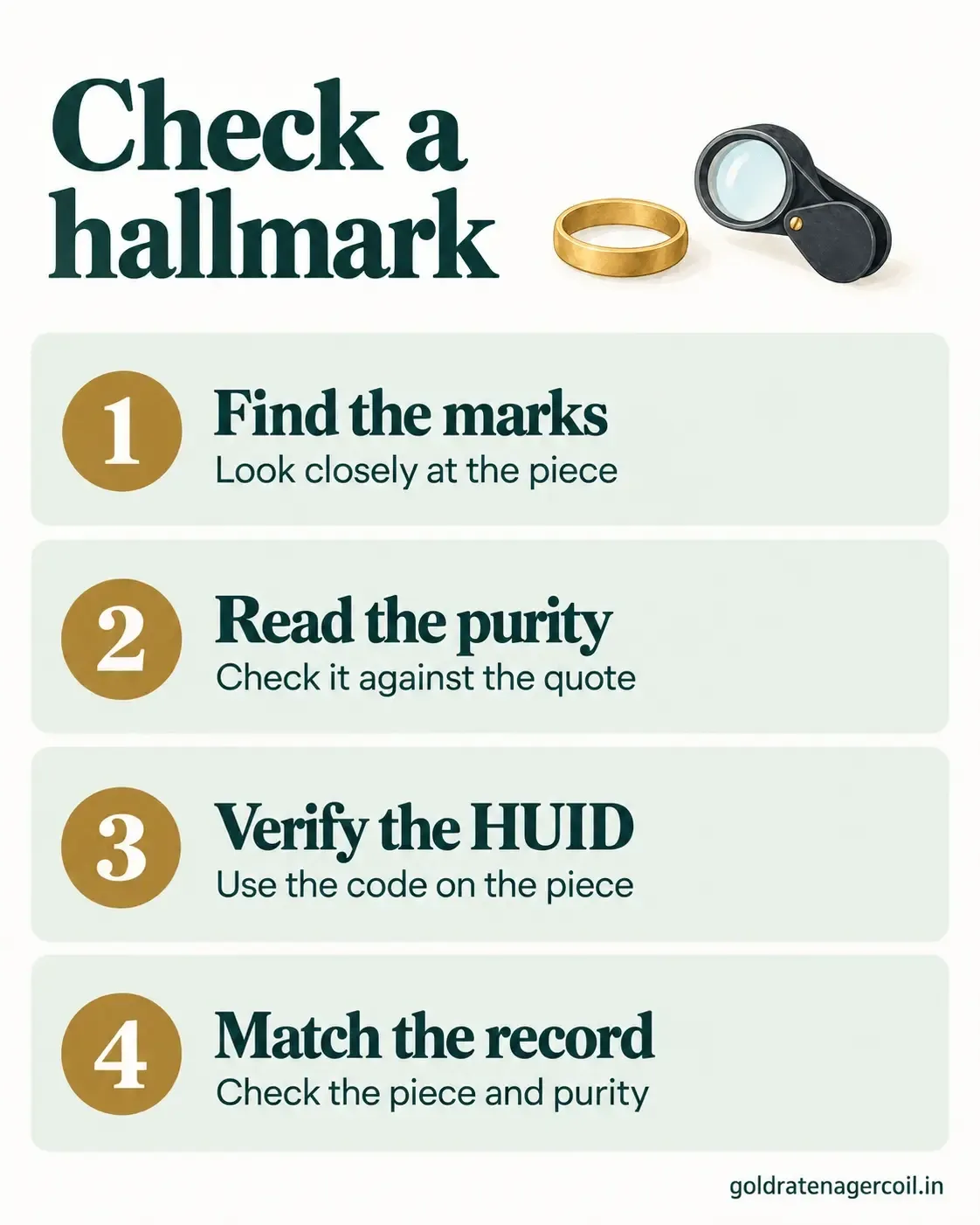
What the BIS Care app does
BIS Care is the Bureau's own app, free, on Android and iOS, in twelve languages. Its Verify HUID feature takes the six characters from the mark and returns the record for that article, including the registration of the jeweller who had it hallmarked. BIS offers the feature as a way to check purity before buying, so use it while the piece is still the shop's.
Type the code exactly as it reads on the article, then reconcile four things.
- The purity the app returns, against the purity on the mark.They are the same claim recorded in two places, and they should match character for character.
- That purity, against the rate you are being quoted.A 22K rate on a piece the record calls 18K is the whole question, and it is cheaper to ask now.
- The article the record describes, against the article in your hand.A code belongs to one piece. A code issued for a light ring does not belong on a heavy chain.
- The jeweller on the record, against the shop you are standing in.A mismatch is not proof of anything by itself, since stock moves between registered sellers, but it is a fair thing to ask about.
Checking a hallmark online
The app is the check. Search results also send buyers to BIS's hallmarking portal at huid.manakonline.in, which is the trade side of the scheme: jeweller registration, the lists of recognised and of suspended assaying and hallmarking centres, the hallmarking representatives and the monthly article counts, behind a single login. It offered no HUID lookup for a buyer on 19 September 2026. A HUID number check is the app.
The HUID may not reach your bill
Putting the HUID on the invoice is voluntary, and a jeweller is not required to keep a record of HUID numbers at all. Copy it off the article yourself. What the bill for a hallmarked article must carry is not voluntary: a description of each article, the net weight of precious metal, the purity in carat and fineness, the hallmarking charges, and a statement that you can have the purity verified at a BIS recognised assaying and hallmarking centre. BIS sets the hallmarking charge at ₹75 per gold article with applicable taxes extra. It is billed per article rather than per gram, and it sits on the bill alongside charges that are not fixed by anyone.
When the marks and the piece do not agree
If the app returns nothing for the code, or returns a purity or an article that is not the one in front of you, stop there. Each of the three routes below is harder once the piece is paid for, and each of them rests on the mark and the bill together.
- Have the purity tested.Any BIS recognised assaying and hallmarking centre will test a consumer's jewellery. Centres take consumers' work on priority, on a chargeable basis, and must issue an assay report identifying the article as it is marked. BIS puts the charge for a fire assay at ₹200.
- Claim the compensation if the purity is short.A buyer whose hallmarked piece tests below its marked purity is entitled to twice the difference in value, plus the testing charges. The registered jeweller who had the article hallmarked is responsible for its purity, and the registered jeweller who sold it is liable to pay.
- Complain to BIS.Through the BIS Care app, through the Standard Promotion Portal on manakonline.in, or by email to [email protected].
The method decides what a purity figure means. An XRF reading is quick and takes nothing off the piece, but it reads the surface and can vary; a fire assay is accurate and destroys a small sample. The difference matters most when a purity figure is being turned into money.
It is also why a test at home settles nothing. Before a centre hallmarks an article at all, it screens it by XRF and sends back to the jeweller anything reading more than five parts per thousand below its declared fineness; only what survives that goes on to be assayed. The mark records the end of that process. Nothing you can do to a piece across a counter reproduces it, which is why the checks worth making are the three marks and the app rather than a test in your own hands.
Getting gold tested near Nagercoil
You do not need the shop's agreement to have a piece tested: a recognised centre takes a consumer's own jewellery directly, and BIS publishes where they are. Its list of recognised assaying and hallmarking centres showed 7 centres in Kanyakumari district with the status Operative: 4 at Nagercoil addresses under pincode 629001, 2 at Marthandam and 1 at Karungal. The same listing gives each centre's recognition number and validity date, and BIS keeps a companion list of cancelled, expired and suspended centres, so check a centre's current entry rather than this count before setting out.
Kanyakumari has been inside mandatory hallmarking from the start: it is one of the 256 districts in the first-phase list dated 23 June 2021. The scheme has grown in seven further phases since, reaching 392 districts on 3 August 2026. So the useful question at a counter here is which exemption an unmarked piece falls under.
That is the whole of what the list establishes: which centres BIS recognised on one day, and where. It does not give their opening hours, whether a particular centre takes a walk-in from a consumer, or what any of them charges beyond the figures BIS sets. No centre is recommended here, and none has been visited.