How to Negotiate Gold Making Charges
On a gold bill, the making charge and any separately quoted wastage are the shop's own price. They are what a negotiation is about. The gold value follows the net weight and the rate per gram, the hallmarking charge is set per article, and GST follows whatever the taxable value turns out to be. So ask for a written itemised estimate before price comes up, work each concession out in rupees on the piece you are buying, and get the reduction recorded in the invoice rather than handed back at the till.
A percentage is easy to concede and hard to compare. Gold making charges come as a percentage of the gold value or as rupees per gram, so turn every figure into rupees on the piece in front of you before you agree to anything.
Start with a written itemised estimate
Ask for the estimate in writing, line by line, before you say what you are willing to pay. An itemised estimate is what shows you which charge the shop is reducing and whether the amount you pay actually falls:
- The weights. Gross weight, the weight of any stones, and the net gold weight that is priced at the rate.
- The purity. In carat and fineness, as the hallmark gives it.
- The rate per gram the shop is working from, for that purity.
- The making charge, with its basis: a percentage of the gold value, or rupees per gram of net gold.
- Any wastage or VA, the percentage, and whether it sits inside the making charge or on top of it.
- The stone price, as an amount the shop sets rather than a weight multiplied by the gold rate.
- The hallmarking charge and the tax, each on its own line.
Ask to see the piece weighed while you are there. A registered jeweller keeps a balance accurate to 0.01 g available for customers, and a magnifier of at least 10x for reading the mark. The bill you are eventually handed has to show a separate description of each article, the net weight of precious metal, the purity in carat and fineness, and the hallmarking charge, and has to tell you that you can have the purity verified at a BIS recognised assaying and hallmarking centre. An estimate that leaves any of that out is not something you can negotiate against.
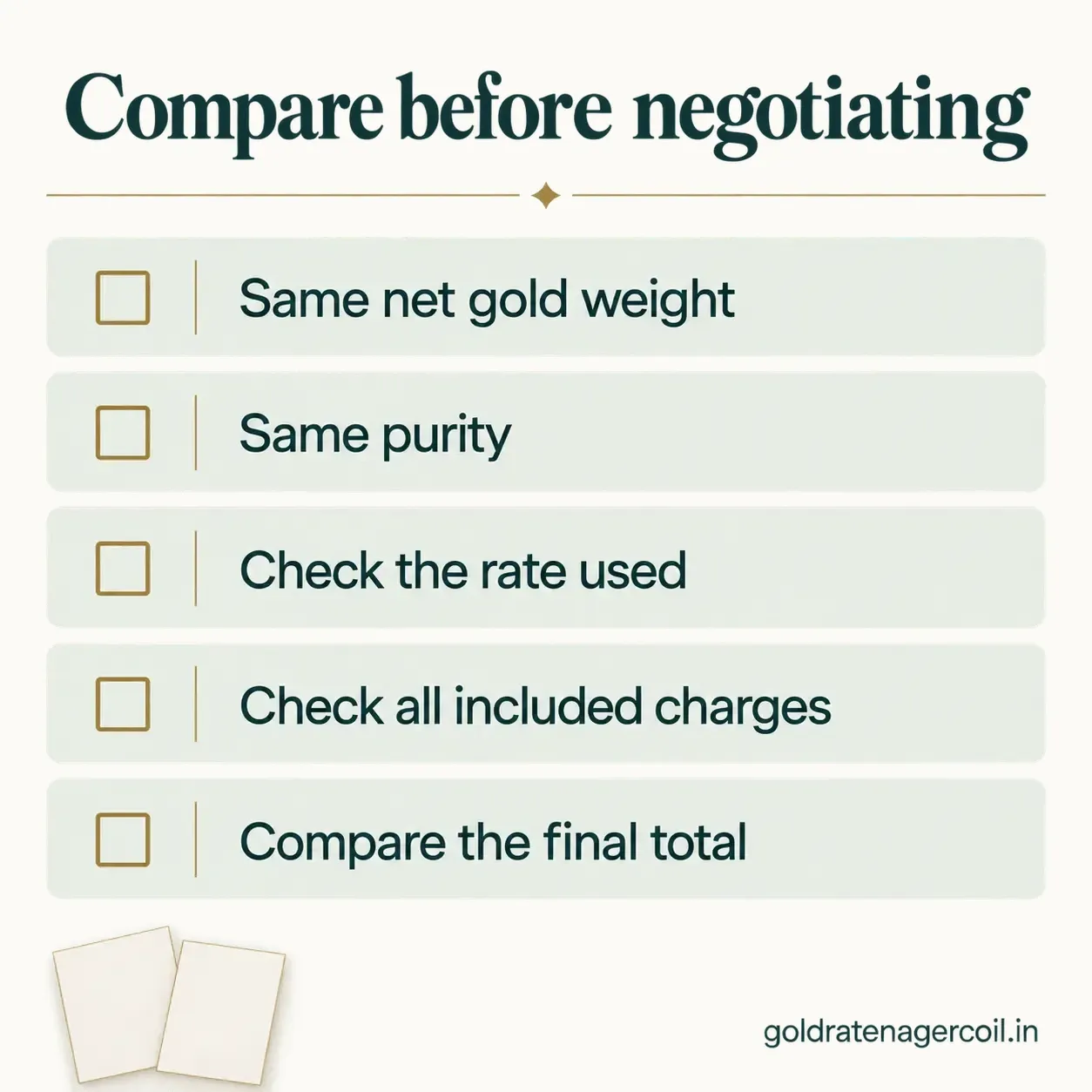
A second written estimate from another shop is the strongest thing most buyers have to bargain with, and it works only if the two price the same thing. Fix the net gold weight, the purity, the rate each shop used and whether wastage is inside the making charge before you compare, then put both quotes on one basis.
Which lines can move, and which cannot
A gold bill mixes prices the shop sets with figures fixed by the weight, the rate and the rules. Only the first group can move.
- Gold value: fixed by the weight and the rate.Net gold weight multiplied by the rate per gram. The weight is the piece you chose. The rate is the shop's board rate, which it may be willing to shade, though the table below shows how little that is worth.
- Making charge: the shop's price for the workmanship.No rule fixes it and no body publishes it, so it is the shop's own figure and the line a reduction can come from. Quoted as a percentage of the gold value or as rupees per gram of net gold.
- Minimum making charge: a floor on that line.Where a floor applies and the calculated charge is below it, the floor is what you pay, so a lower percentage changes nothing until the calculated charge climbs back above it. Ask whether one applies before arguing about the percentage.
- Wastage or VA: the same arithmetic as the making charge.A percentage of the gold value when it is quoted separately. VA is reported both for the wastage alone and for the making charge and the wastage together, so ask what the figure covers before you ask for less of it (how wastage is charged).
- Stones: a price the shop sets.Their weight comes out of the gross weight to leave the net gold; their price is a separate amount, and it can be discussed like any other.
- Hallmarking: a small fixed line.BIS sets the hallmarking charge at ₹75 per article for gold, with applicable taxes extra. It is per article rather than per gram, so it is not where a negotiation goes; it has to appear as its own line.
- GST: follows the value down.3% of the total transaction value of the jewellery, making charge included. Every rupee off a charge takes its tax with it.
What each concession is worth on a one-pavan bill
Concessions that sound similar are not worth similar money. The same quote below is reduced five ways, each carried through the bill to the figure you would pay.
Example: five ways to take something off one quote
One pavan, 8 g of net 22K gold at ₹14,000 per gram, a round example rate rather than today's, with 12% making and 5% wastage quoted separately. The percentages are illustrations of the arithmetic, not a Nagercoil shop's figures and not a reduction any shop has agreed to. The quote as it stands comes to ₹1,34,971.
| What you ask for | Bill | Off the bill |
|---|---|---|
| Making charge 12% to 10%Making falls from ₹13,440 to ₹11,200 | ₹1,32,664 | ₹2,307 |
| Wastage 5% to 3%Wastage falls from ₹5,600 to ₹3,360 | ₹1,32,664 | ₹2,307 |
| ₹100 per gram off the rateGold value falls by ₹800, and both percentage charges with it | ₹1,34,007 | ₹964 |
| ₹2,000 off, recorded in the invoiceThe taxable value drops to ₹1,29,040 before the tax is worked | ₹1,32,911 | ₹2,060 |
| ₹2,000 handed back after the totalThe tax had already been worked on the full value | ₹1,32,971 | ₹2,000 |
Which line is worth asking about
A point off the making charge and a point off the wastage come to the same money. Both are percentages of the same gold value, so at this rate a point off either is worth ₹1,120 before tax, wherever the shop prefers to take it from. Add the two percentages together, ask for a figure off the total, and compare shops on that combined number.
₹100 a gram off the rate sounds like the largest item on the list and is the smallest. On 8 g it is ₹800 of metal, and even after dragging the two percentage charges down with it, it comes to ₹964 against ₹2,307 for two points off the workmanship. A shop can afford to move the line that costs it least, so name the line you want moved.
The same ₹2,000 is worth ₹60 more on the invoice than at the till, because the tax then has to be worked on the value after it.
A percentage making charge is recalculated on whatever rate the bill is worked at, so a quote worked on one day's rate is not a quote on another's. A concession agreed as a figure in rupees, or as rupees per gram of net gold, survives that. Ask which day's rate the bill will use.
Questions to ask about a reduction
Each one attaches to a line the shop has to be able to state, so the answers can be checked against the estimate and against the next shop's.
- "Can I have this estimate in writing, with the net weight, the purity and each charge on its own line?" Without it there is nothing to compare, and nothing to hold the shop to afterwards.
- "Which rate per gram is this worked on, and is that the rate I will be billed at?" A quote and a bill worked at different rates are different prices, and a percentage charge moves with the rate.
- "Is the making charge a percentage or per gram? Can you give me the reduction as a rupee figure?" A figure cannot be quietly recalculated later; a percentage point can.
- "Does the wastage or VA figure include the making charge, or is it on top?" Until you know this for both quotes, you cannot tell which shop is asking for more.
- "Is there a minimum making charge on this piece?" If the floor is what you are paying, a lower percentage is worth nothing, and the conversation has to move to another line.
- "What are the stones priced at, separately from the gold?" A stone price is an amount, not a weight multiplied by the gold rate.
- "If you take something off, will it be on the invoice before the tax?" The same reduction is worth 3% more recorded there than handed back after the total.
- "Will the bill show the net weight, the purity and the hallmarking charge separately?" For a hallmarked article it has to, and it is what you check the agreed figures against before paying.
Reading an offer on making charges
An offer on making charges names one line of the bill. The metal, the wastage and the stones are still priced the same way, so settle what it leaves untouched:
- Which rate per gram the bill will use, since that is where most of the money is.
- Whether wastage or VA is still charged, and at what percentage. Waiving the making charge while charging wastage leaves part of the workmanship on the bill.
- Whether a minimum making charge applies. A percentage waived above a floor still leaves the floor.
- What the stones cost, which no making-charge offer touches.
- Whether the reduction is worked on the making charge or on the bill, and whether it reaches the invoice before the tax.
- Which pieces it covers, and until when.
A single all-in figure can still be bargained over. What it cannot tell you is which charge moved, or whether the shop took the reduction out of a line it had padded. Take the tax out, subtract the gold value at the shop's own rate, and what is left is everything charged above the metal.
Get the reduction onto the invoice, before the tax
A reduction agreed at the counter is worth the tax on it as well, but only where the invoice records it. GST is charged on the transaction value, the price actually paid or payable for the supply, and a discount given before or at the time of the supply is left out of that value only where it is recorded in the invoice issued for it. A reduction that appears afterwards, as cash back or a note on a slip, comes off a figure the tax has already been worked on.
Checking it takes one line of the bill. A tax invoice has to show the total value of the supply, the taxable value after any discount, the rate of tax and the amount of tax charged. So find the taxable value, confirm it is the figure you agreed rather than the one before the reduction, and confirm the tax is worked on that.
Ask for the agreed figures to stay on the written estimate too. It is what you read the final bill against, and the only record you have if the two do not match.
Checking a one-pavan quote against the Nagercoil gold rate
The latest 22K gold rate in Nagercoil is ₹14,010 per gram, ₹1,12,080 per pavan (8 grams), as on 25 September, 9:36 am. Before charges come up, that figure tells you roughly how much of a one-pavan quote is metal: the distance above it is the part you are negotiating over, and a quote close to it leaves almost nothing for workmanship.
Your jeweller's board rate may differ from it. Making charges, any separately quoted wastage and GST come on top.
Work the figure out on the shop's own rate per gram rather than this one, because a different board rate would turn up in your answer as workmanship. Every making charge and wastage percentage here is an illustration, not a figure any Nagercoil shop has quoted. What a shop will agree to is between you and the shop; what these give you is the arithmetic to hold its quote to.